As one of the sunniest locales in the country and with good Las Vegas solar incentives, it’s no surprise that as of 2023, Nevada ranks 6th in the nation for solar power usage.
By 2030, the state plans to have 50 percent of its energy needs powered by renewable sources.
Yet, altough still considered a relatively expensive addition to the home, solar power installation costs have decreased steadily over the years, with prices in the Silver State coming down 43 percent since 2013. This means that it’s easier than ever to implement renewable energy in your home in Las Vegas.
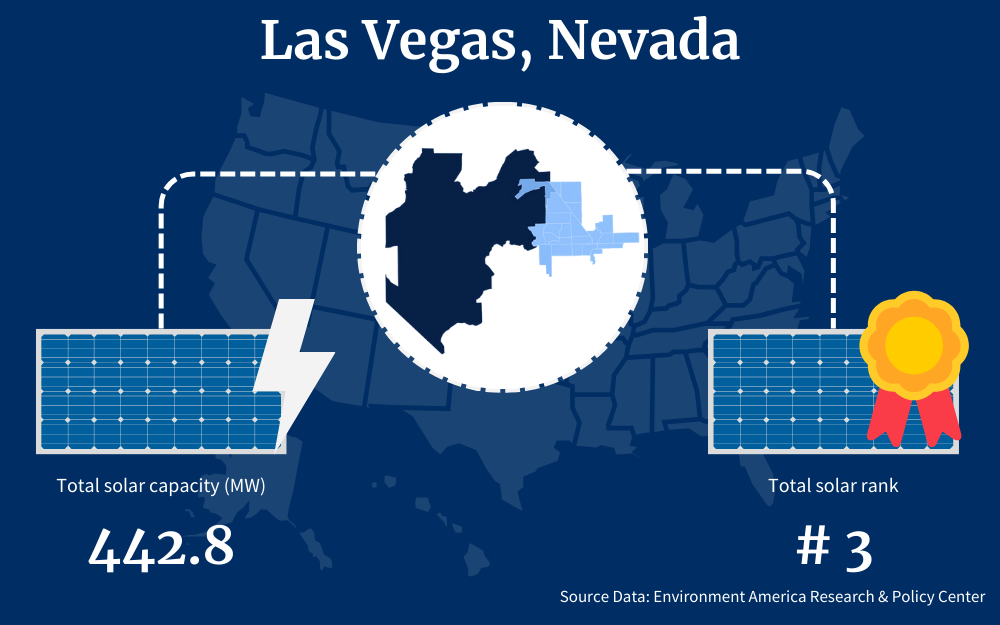
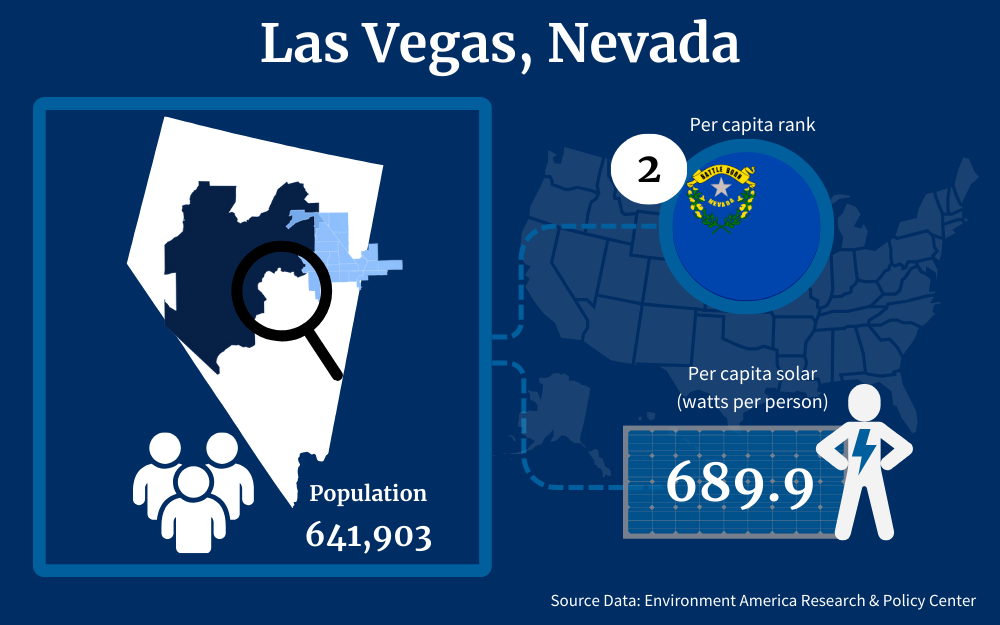
While the city doesn’t offer as many Las Vegas solar incentives as other cities or counties, there are still ways to make the transition to solar energy more cost-effective and save money on home solar installation.
Las Vegas Solar Credits Overview
Here is a brief overview of the different solar credits available in Las Vegas.
What Are Solar Credits?
Solar tax credits reduce your tax liability by allowing you to deduct a portion of your solar power system expenses. Unlike deductions that merely lower taxable income, credits are applied directly to your balance.
For example, if you owe $10,000 and receive a $5,000 solar tax credit, you would now only owe $5,000 in taxes.
Federal and State Credits
Nevada does not currently offer any state-level tax credits to reduce your state tax liability, making the federal tax credit (more info below) the only option for residents here.
How Do I Claim My Credits?
There are no special applications to claim the federal credit. You simply need to fill out the specific tax form for this program where you input the various expenses associated with your system and enter the final calculation on your 1040, the standard individual federal income tax form.1
All in all a pretty straightforward process.
Renewable Energy Programs Offered by the Government: Residential Clean Energy Credit
The Residential Clean Energy Credit,2 formerly known as the Federal Investment Tax Credit (ITC) is a federal program that allows you to deduct 30% of your installation costs—including ‘soft’ costs like permitting and inspection— for the tax year you installed your solar power system.
This program has been around for quite some time. But the validity period and various offerings—including increasing the tax credit— have been expanded under the Inflation Reduction Act of 2022.
After 2032, the credit will reduce over the next few years, with the program expiring in 2035 unless Congress renews it.
This credit is non-refundable, meaning if the amount of credit you qualify for exceeds your tax liability (the amount due to the federal government) the most you can do is reduce your balance to zero.
You won’t get a refund for the remaining amount of credit. For example, if you owe $5,000 and your credit is $6,000, you will not receive a $1,000 refund.
But there’s good news: you can apply unused credit to next year’s taxes. There is no limit to how much money you can claim with this credit, and you can use it any year you install eligible equipment — including other forms of clean energy besides solar — so long as the program is still active.
A few considerations for utilizing this credit:
- The equipment must be brand new and installed in your primary residence. You cannot use this credit for systems installed in other properties you own but do not live in, like a home you rent to others.
- It must be your first time installing a solar power system on your property.
- You must own the equipment, whether bought in cash or with a solar loan.3 If you lease the equipment, the leasing company claims the credit, typically lowering your payments, meaning you still benefit from this incentive, even if indirectly.
- You must deduct certain types of rebates, subsidies, and other Las Vegas solar incentives from the qualifying expenses total. Public utility subsidies must be subtracted, but utility payments for sending energy back to the grid, such as net metering, do not.
This information is not an exhaustive analysis of this credit. Before doing your taxes, it’s best to consult with a tax professional if you’re not sure how to properly apply this or any other credit or deduction to your taxes.
Can I Sell Power Back to the Grid?
Some states, if not cities, allow residents with solar panel installation in their homes to sell solar power to electric utilities. Here are some programs that allow you to do so.
Net Metering
Known as net-metering,4 selling power back to the grid is a primary way Nevada residents offset the costs of their solar power system. While this incentive might not offer as immediate and substantial a financial reward as tax credits and rebates, this is one of the longer-term Las Vegas solar incentives that consistently puts cash back in your pocket with credits to your electric bill (not cash payments).
In states that offer it, net metering allows residents to store excess energy on the electrical grid, which is used for other customers or your home when solar power is unavailable, such as in the evenings or poor weather. You bank credits for this excess energy and will only be charged for grid power if your usage exceeds the credits you have banked.
One of the biggest reasons people end up with surplus energy is that most solar power gets produced in the afternoons when the sun is strongest, but that is also the time of day when power consumption is lowest.
Solar Power Purchase Agreement (PPA)
A solar Power Purchase Agreement (PPA) is a contract between you and a solar power system provider or local utility company that typically lasts 20-25 years,5 allowing you to access solar power at wholesale prices.
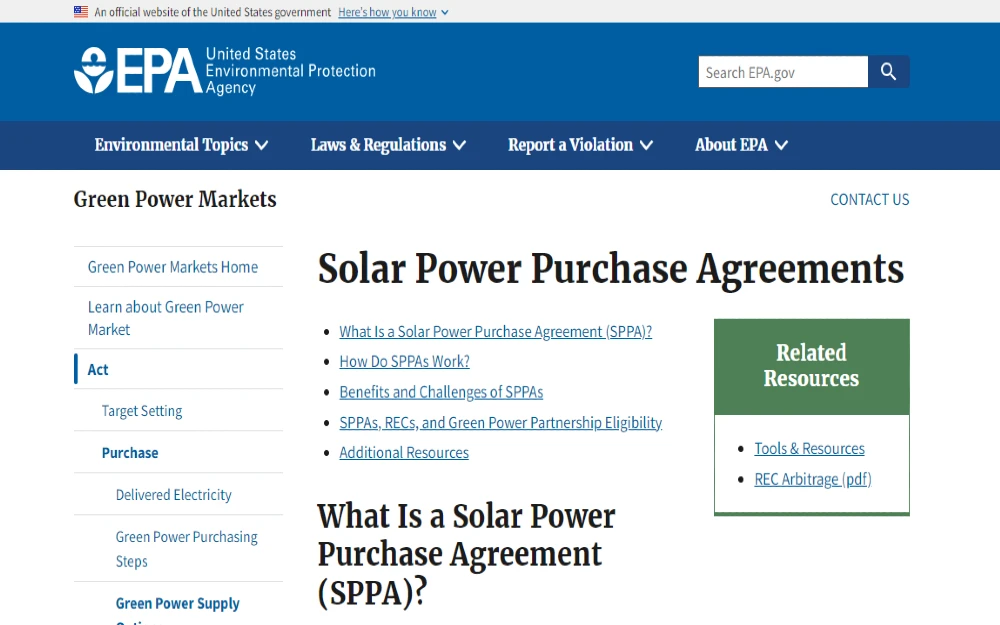
A PPA is a good option for people who can’t afford solar power systems, are reluctant to make such a substantial investment, or don’t want to deal with maintaining the system on their own. The provider assumes full responsibility for the installation and maintenance.
Providers generally offer many customization options for the contracts, allowing for an agreement highly tailored to your needs.
Some considerations for the contract:
- Choose a company with a solid reputation and financial history. A PPA is a long-term commitment where you want to minimize any risk of problems or the agreement not being implemented as expected.
- Study the terms carefully. Understand the conditions for early termination and associated fees.
Will you receive a fixed rate per watt for the whole contract? Or will it change over time?
Some agreements contain ‘elevator clauses’ that raise rates over time. - The rates charged may or may not result in significant savings over regular electricity use. So be sure you fully understand costs and your current energy consumption costs.
How To Apply for Solar Credits and Rebates in Las Vegas
Considering the potential for solar power in such a sun-drenched locale, and how much it already uses compared to other states, Nevada has some pretty weak incentives.
Currently, Nevada does not offer state-level tax benefits such as credits, property tax, sales tax exemptions, etc. The aforementioned federal credit is the only option for now, and claiming this is as easy as filling out the required IRS form along with your regular tax forms.
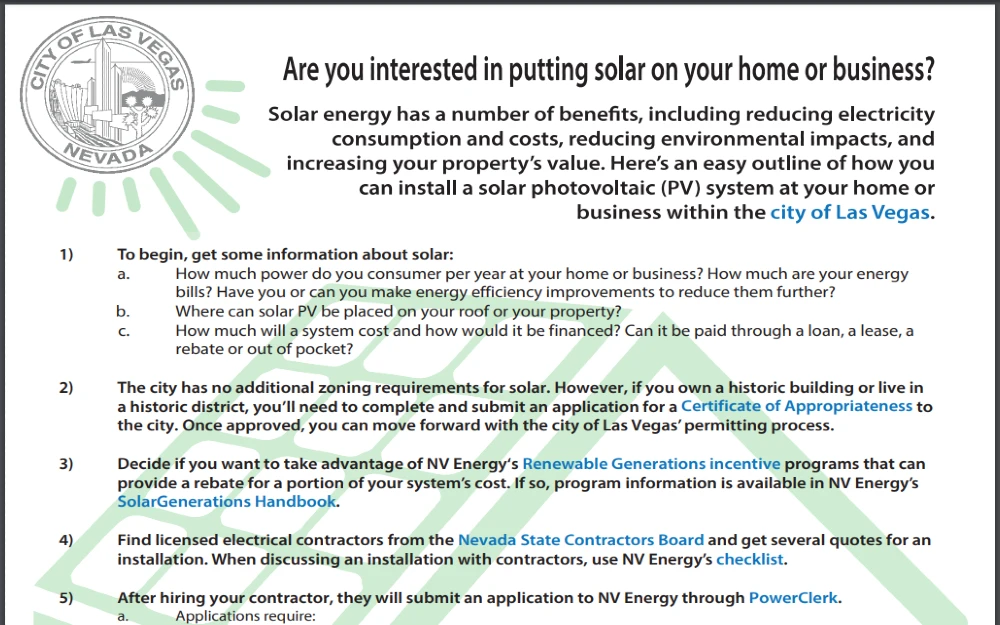
As of 2023, the state does not offer any rebate programs to offset the cost of installing a solar power system, but equipment providers may provide such rebates and other incentives. This potential avenue of savings is an especially good reason to shop around for quotes and become familiar with the offerings of at least a few companies that serve your area.
Net metering is the most valuable incentive, and you need to apply through NV Energy, the only provider in the state that offers it. It owns two other utility providers here, so it covers everywhere.
You can view the application here after logging into your customer account.6 Note as of June 2023, the utility no longer accepts applications for its solar battery incentives program.
Home Solar Installation Expenses and Materials: Solar System Cost
As of September 2023, solar energy in the state costs $ 2.60/W.
The average system size in Nevada is about 8kW (8,000 watts), which would cost about $21,000, or a bit less than $15,000 after the federal tax credit. This per-watt figure may be higher when accounting for the numerous factors that will influence the total project cost.
Some Factors Influencing the Price
Here are some of the factors that will influence the price of solar panel system installation.
- Energy Needs
How much energy do you need? The more you need, the more panels you need to purchase.
How much people want to offset regular energy costs through solar can vary, with some aiming to rely on it 100 percent if possible.
- Quality of the Panels
While several things may impact the product price, the primary factor is efficiency. The higher the percentage of the sun’s rays it can turn into usable energy, the pricier that brand of panels will be.
- Installation Requirements
Different homes have different installation requirements. For example, depending on the panel placement, you may need to pay extra for more extensive wiring.
To properly install the panels, you may need roof work.
Solar System Materials
Aside from your energy needs, quality of panels, and requirements, solar panel system materials will also dictate the total price of your system. Here is a list of the different components of solar systems and their functions.
- Solar Panels
First and foremost, you need the panels, and you may wonder what materials comprise them. Semiconductor material accounts for the bulk of solar panels –which convert the sun’s energy into power.
Ninety-five percent of solar modules use silicon for such purposes. It is abundant and efficient, with these panels maintaining 80% of their output after 25 years.
There are two basic types of panels: monocrystalline and polycrystalline, with the former being more expensive. Both consist of silicone, but monocrystalline panels are more efficient and have a darker hue, which absorbs more energy.
- Inverters
How solar power works is pretty basic.
The panels absorb the energy of the sun and convert it to direct current (DC) power that runs through your home’s power system. However, because most homes use alternating current (AC) power, the system requires an inverter to convert DC to AC.
There are different types from which to choose:
- String inverters connect all your panels as a single unit. They are cheaper, but if one panel isn’t performing as well—because of shading for example— it can affect how well the energy converts overall.
- Microinverters are attached to each panel separately, which maximizes energy production. This option allows you to monitor each pane’s output, which some homeowners find helpful.
Naturally, this is more expensive and typically unnecessary for homes with optimal roof conditions–south-facing and plenty of room to place all the panels in the same direction. - Power optimizers are like a hybrid of microinverters and string inverters. Like the former, they attach to each panel but don’t convert the energy as efficiently.
As you can tell by the name, they are not actually inverters. They ‘prep’ the DC for conversion and then send it to a centralized inverter. - Solar Racking
When looking at solar panels from a distance, it appears they are attached directly to the roof, but this is not so.
The installers mount them on equipment known as solar racking. This equipment serves multiple purposes, such as minimizing damage to your roof and allowing the panels to be installed at optimal angles to maximize performance.
The mention of this particular equipment is a good place to mention that solar panels are not only placed on roofs but mounted on the ground for various reasons, such as a roof being too small for the number of panels required. You would also use racking equipment here to mount the panels in one spot and angle permanently or in an adjustable position to follow the sun through the day.
- Monitoring Equipment
Getting the most out of your solar energy system requires carefully tracking your system performance, and this is where monitoring equipment comes in. How satisfying is it to see your energy bills drop steadily over time?
It also alerts you to any performance issues that impede optimal functioning.
Remember: Efficiency is the name of the game with solar energy production. You can opt for on-site monitoring installed with the panels or off-site systems accessed online.
- Energy Storage
Solar batteries allow you to draw on stored energy in the evenings or when poor weather conditions lend themselves to reduced energy production. Whether this optional equipment–which is still relatively expensive– makes sense for you will depend on a number of factors.
If you live in a state with net metering—like Nevada— you may not need a battery since you can store excess energy your system produces on the grid, and draw on it as necessary. If you opt for storage, as of 2023, it counts as one of the qualifying expenses for the 30% federal tax credit.
Solar Panel Calculator: Requirements and Cost Savings
Many factors determine the total cost of your solar power project, such as the number of panels you need,7 their wattage and how efficiently they convert energy, how much peak sunlight your area receives, household energy consumption, and roof conditions.
While you probably couldn’t calculate the exact figure on your own before moving forward with the project–the installer will take care of the math ultimately– you can run some rough numbers to get a sense of the investment.
Basic Formula
To calculate your panel needs, divide the number of kW (kilowatts) you need by the wattage of the solar panels.
kW needed/Solar panel wattage = Number of panels needed
Most panels designated for residential use rate between 250 and 400 watts, with the most efficient being between 370 and 445. The higher the rating, the more kWh (kilowatt hours) the panel will produce.
How To Determine the Number of Solar Panels
The following will help you determine the answer to the above formula.
Step 1: Check your electric bills over the last 12 months to see how many kWh you use monthly.
Step 2: Divide your monthly consumption by 30.42 to get daily use figures (365 days/12 months)
Step 3: Determine how many peak hours of sunlight your location receives. This number is an important part of the calculation since this is when the panels will produce almost all the energy they can.
Divide the daily energy consumption figure from step 2 by peak sunlight hours. This figure will give you the amount of energy you need daily.
Step 4: Calculate the panel’s output. You can play around with different wattages, remembering the typical residence will use 250 to 400-watt panels.
Convert the watts to kilowatts by dividing the wattage by 1,000 to get the panel’s output.
Step 5: Divide the daily energy use (figure in Step 3) by the panel’s output (figure in Step 4) to determine the number of panels required
How Much Money Will I Save With Solar?
On average, Nevada residents will recoup the cost of their solar panels in 9 to 12 years. Since a solar power system generally lasts 25 years or longer, you will experience significant savings with solar energy, especially considering both energy usage and costs in the state are higher than the national average.
Exact figures will depend on several factors, from how much you rely on solar energy to power your home to your system design. But generally, a Nevada resident may save anywhere from $67,000 to $110,000 over 25 years, depending on inflation rates.
How To Find Las Vegas Solar Panels
Nevada has over 80 solar companies, with over three dozen focusing solely on solar panel installation. Solar panel installation is a complex, expensive undertaking, and with so many companies available to you, it is paramount to understand what to look for in a service provider.
What To Look For in a Solar Company
Proper credentials are a must. A reputable installer will be certified by the North American Board of Certified Energy Practitioners (NABCEP)8 and licensed, bonded, and insured to provide its services in your area.
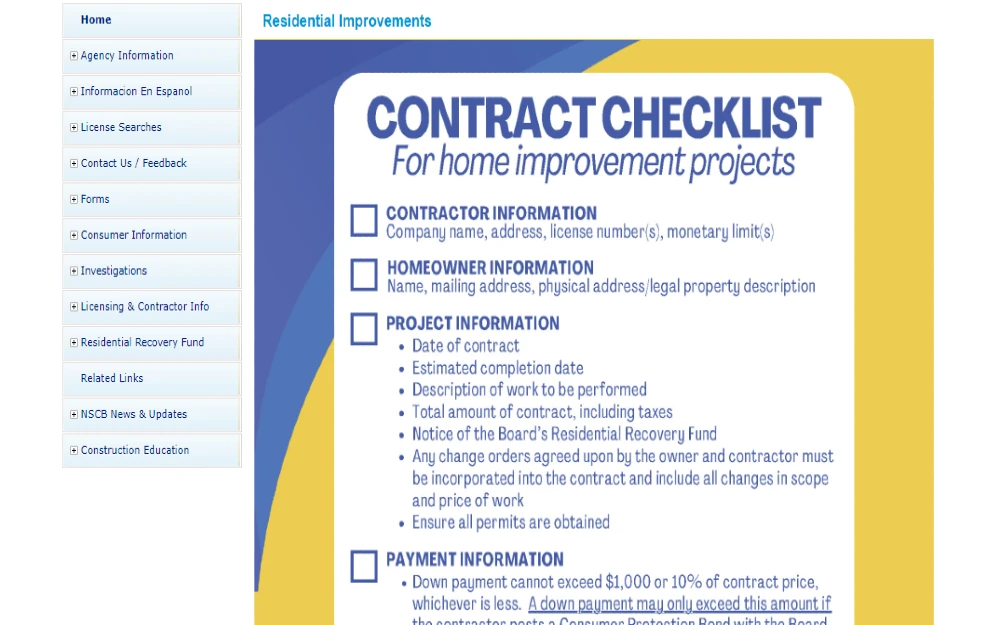
Choose installers with at least a few years of experience. Notice how well they answer your questions.
- Do they seem knowledgeable about the panels and other equipment?
- Can they clearly explain why the products they do?
- Do they seem well-informed about Las Vegas solar incentives and rebates available to you?
- Do they clearly outline the warranty terms?
A good solar installer will be transparent about all aspects of such a big project and won’t hesitate to answer any of your questions about any part of the process.
One of the most important questions is whether they use subcontractors for any part of the installation. If so, they should clearly explain who will be doing what.
Other Considerations
Get quotes from at least three providers. Referrals from trusted friends, family, and neighbors are always good, especially for such an expensive project.
Check if the company has any complaints registered on the Better Business Bureau.9
Nevada’s climate makes it an ideal location for taking advantage of the sun’s energy to serve your power needs.
As you can see, several incentives make the transition to solar power more financially feasible, and the long-term savings are substantial. Not only is solar power helpful for the environment, but it is even more helpful to your wallet through the Las Vegas solar incentives!
Frequently Asked Questions About Las Vegas Solar Incentives
What Are the Net-Metering Rates in Las Vegas?
As of 2017, residents receive credits equal to 75% of the retail electricity rates charged to non-solar customers. If your credits exceed your bill for the month, they are carried over to the next bill.
Here in Nevada, you can roll over credits indefinitely. You will receive the current rate for 20 years, which will remain 75% unless the state legislature changes the law.10
Does Solar Power Increase My Home Value in Las Vegas?
Your home value could increase by $4 for every solar power watt. The average home in Nevada has an 8 kW (8,000 kW) system, which means a potential property value increase of $32,000! With abundant sunshine, Nevada residents can handily recoup their investment, making these increases pure profit.
References
1Internal Revenue Service. (2022, December 6). Residential Energy Credits [PDF file]. IRS. Retrieved October 11, 2023, from <https://www.irs.gov/pub/irs-pdf/f5695.pdf>
2Solar Energy Technologies Office. (2023, March). Homeowner’s Guide to the Federal Tax Credit for Solar Photovoltaics. Office of Energy Efficiency & Renewable Energy. Retrieved October 11, 2023, from <https://www.energy.gov/eere/solar/homeowners-guide-federal-tax-credit-solar-photovoltaics>
3U.S. Department of Energy. (2013, October 8). The Borrower’s Guide to Financing Solar Energy Systems: A Federal Overview. NREL. Retrieved October 11, 2023, from <https://www.nrel.gov/docs/fy99osti/26242.pdf>
4State of Nevada. (2023, October 9). Net Metering in Nevada. State of Nevada Public Utilities Commission. Retrieved October 11, 2023, from <https://puc.nv.gov/Renewable_Energy/Net_Metering/>
5US Environmental Protection Agency. (2023, February 5). Solar Power Purchase Agreements. EPA. Retrieved October 11, 2023, from <https://www.epa.gov/green-power-markets/solar-power-purchase-agreements>
6Clean Power Research, L.L.C. (2023). NV Energy’s portal for net metering applications. NV Energy. Retrieved October 11, 2023, from <https://nvenetmeter.powerclerk.com/MvcAccount/Login>
7Johnson, A. (2013, November 19). How many solar panels do I need on my house to become energy independent? MIT School of Engineering. Retrieved October 11, 2023, from <https://engineering.mit.edu/engage/ask-an-engineer/how-many-solar-panels-do-i-need-on-my-house-to-become-energy-independent/>
8NABCEP. (2023, October 10). NABCEP Home Page. NABCEP. Retrieved October 11, 2023, from <https://www.nabcep.org/>
9Better Business Bureau. (2023). Better Business Bureau Home Page. Better Business Bureau. Retrieved October 11, 2023, from <https://www.bbb.org/>
10State of Nevada Public Utilities Commission. (2016, March 23). NET METERING RATES & RULES. State of Nevada Public Utilities Commission. Retrieved October 11, 2023, from <https://puc.nv.gov/uploadedFiles/pucnvgov/Content/Consumers/Be_Informed/Fact_Sheet_Net_Metering.pdf>
11Nevada Governor’s Office of Energy. (2015, July 13). Nevada Solar Installation Contractors. Nevada Governor’s Office of Energy. Retrieved October 11, 2023, from <https://energy.nv.gov/uploadedFiles/energynvgov/content/Pages/Nevada%20Solar%20Installation%20Contractors(1).pdf>
12Screenshot of contract checklist. Nevada State Contractors Board. Retrieved from <http://nscb.nv.gov/residential_improvements.html>
13Screenshot of solar information. City of Las Vegas. Retrieved from <https://files.lasvegasnevada.gov/planning/Solar-Information.pdf>
14Screenshot of solar power purchase agreement. EPA. Retrieved from <https://www.epa.gov/green-power-markets/solar-power-purchase-agreements>